

1. Core Policy Changes in Saudi Arabia at a Glance
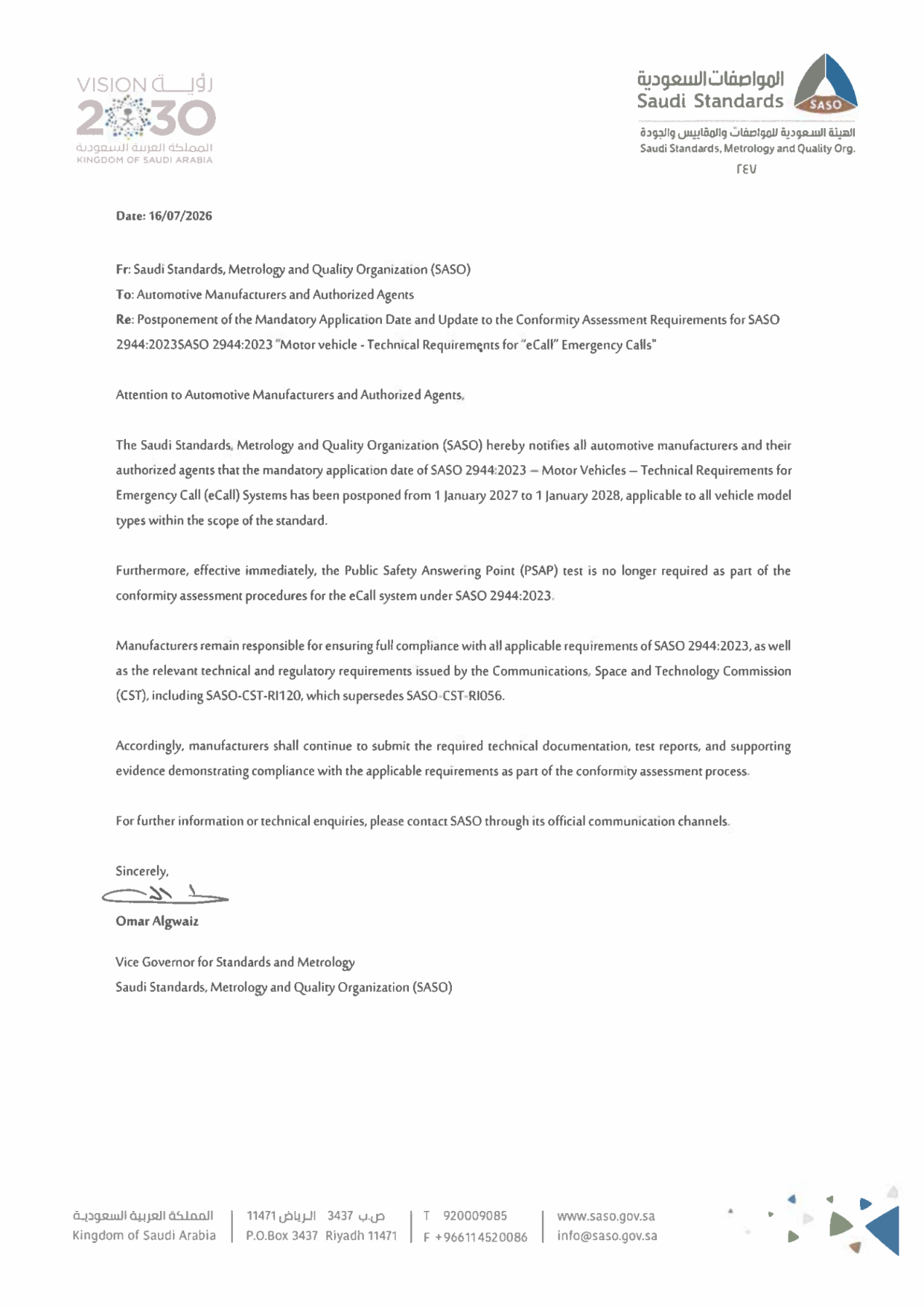
On July 16th, the Saudi Arabian Standards Organization (SASO) announced that the mandatory implementation date of SASO 2944:2023 "Technical Requirements for Emergency Call (eCall) Systems in Motor Vehicles" has been postponed from January 1, 2027 to January 1, 2028, and the mandatory PSAP test report requirement in the vehicle certification process has been explicitly canceled.
2. Complete Official Document Translation
Date: July 16, 2026
From: Saudi Arabian Standards Organization (SASO)
To: All Motor Vehicle Manufacturers and Authorized Agents
Subject: Postponement of Mandatory Implementation Date and Update of Conformity Assessment Requirements for SASO 2944:2023 "Technical Requirements for Emergency Call (eCall) Systems in Motor Vehicles"
To all motor vehicle manufacturers and authorized agents:
1. Adjustment of Implementation Time:
The Saudi Arabian Standards Organization (SASO) hereby notifies all motor vehicle manufacturers and their authorized agents that the mandatory implementation date of the SASO 2944:2023 standard "Technical Requirements for Emergency Call (eCall) Systems in Motor Vehicles" has been postponed from January 1, 2027 to January 1, 2028. This requirement applies to all vehicle models within the scope of this standard.
2. Update of Testing Requirements:
During the conformity assessment process for the eCall system in accordance with SASO 2944:2023, the mandatory public safety answering point (PSAP) interface test is no longer required, and this requirement is immediately effective.
3. Compliance Responsibility Requirements:
Manufacturers remain fully responsible for ensuring that their products fully comply with all applicable provisions of SASO 2944:2023, and also meet the relevant technical regulatory requirements issued by the Communication, Space and Technology Committee (CST), including SASO-CST-RI120 (this document replaces the previous version SASO-CST-RI056).
4. Requirements for Assessment Materials:
Manufacturers must continue to submit complete technical documents, test reports, and supporting materials to prove that the vehicle meets all applicable regulatory provisions during the conformity assessment process.
For more information or technical inquiries, please contact the organization through SASO's official communication channels.
3. Summary and Extension of Key Information
Vehicle Certification (Discussed in Two Scenarios):
1. Vehicles Equipped with eCall:
The in-vehicle eCall must comply with all applicable provisions of SASO 2944:2023, and the vehicle must be equipped with an NG eCall for witnessed testing. After passing the test, a SASO 2944:2023 vehicle eCall test report will be issued, which will be an essential part of vehicle certification.
2. Vehicles Without eCall:
Before the entry into force of the regulations on January 1, 2028, the NG eCall vehicle test can be directly exempted;
After the entry into force of the regulations on January 1, 2028, all vehicles subject to SASO 2944:2023 must supplement the witnessed NG eCall vehicle crash test (ECE R94 and ECE R95) and update the SASO vehicle certificate.
Component Certification:
1. No change in applicable vehicle model range: The postponement only provides a buffer period; products still fully meet all standard provisions and are not exempt from compliance requirements;
2. PSAP test report: No longer listed as a necessary document for vehicle access certification.
4. Screenshot of the Official Notification
Wanve can provide one-stop SASO vehicle and component compliance consulting services to assist vehicle manufacturers in complying with regulations for export to the Middle East.
